Board Insight Studio is currently in development. A limited pilot is being designed to evaluate its usability and potential contribution to nonprofit board development.
The Nonprofit Board Accelerator

Discover what you
bring to the boardroom.

Board Insight Studio is a research-informed board development approach, currently in development, designed to help nonprofit board members explore their strengths and the board work where they may add the most value.

35+
Built by a recognized leader who has served as a nonprofit executive and board member at the local and national levels, teaches the Big Five framework to undergraduate business students, and is a published voice on nonprofit board governance in the American Alliance of Museums' magazine.
5
Big Five personality traits. A personality framework widely studied in academic psychology, applied here to the important work of nonprofit boards.
15
Minutes to complete. A Big Five assessment, a personalized report, and a shared language for your whole board.
What you’ll discover

Three views of your boardroom contribution.

Every participant receives a personalized report with three linked insights: a leadership signature, a place in the board transaction cycle, and a map of the strengths you bring to governance.

01 · Signature

Your Leadership Signature

Your top two personality traits combine into a distinctive boardroom archetype. The Relational Rainmaker, the Reliable Steward, the Analytical Futurist, and seven others. Each comes with the natural roles, strengths, and contributions it brings to the board.

02 · Placement

Your Place in the Cycle

Board Insight Studio uses a proposed five-part framework to organize essential areas of nonprofit board work. Your personality profile may offer useful insight into the kinds of board work you may find energizing or approach in a distinctive way, and how your contribution fits the whole.

03 · Profile

Your Strengths & Shadows Map

A clear profile across all five Big Five personality dimensions. What each trait means for board work, where it’s a strength, and the tradeoffs worth knowing. Nothing to fail. Everyone has both.

For your leadership

And for your Board Chair and CEO.

Your Board Chair and Executive Director can manage the engagement through a private dashboard that gives them the collective picture — informing committee assignments, board recruiting, and the broader work of strong governance.
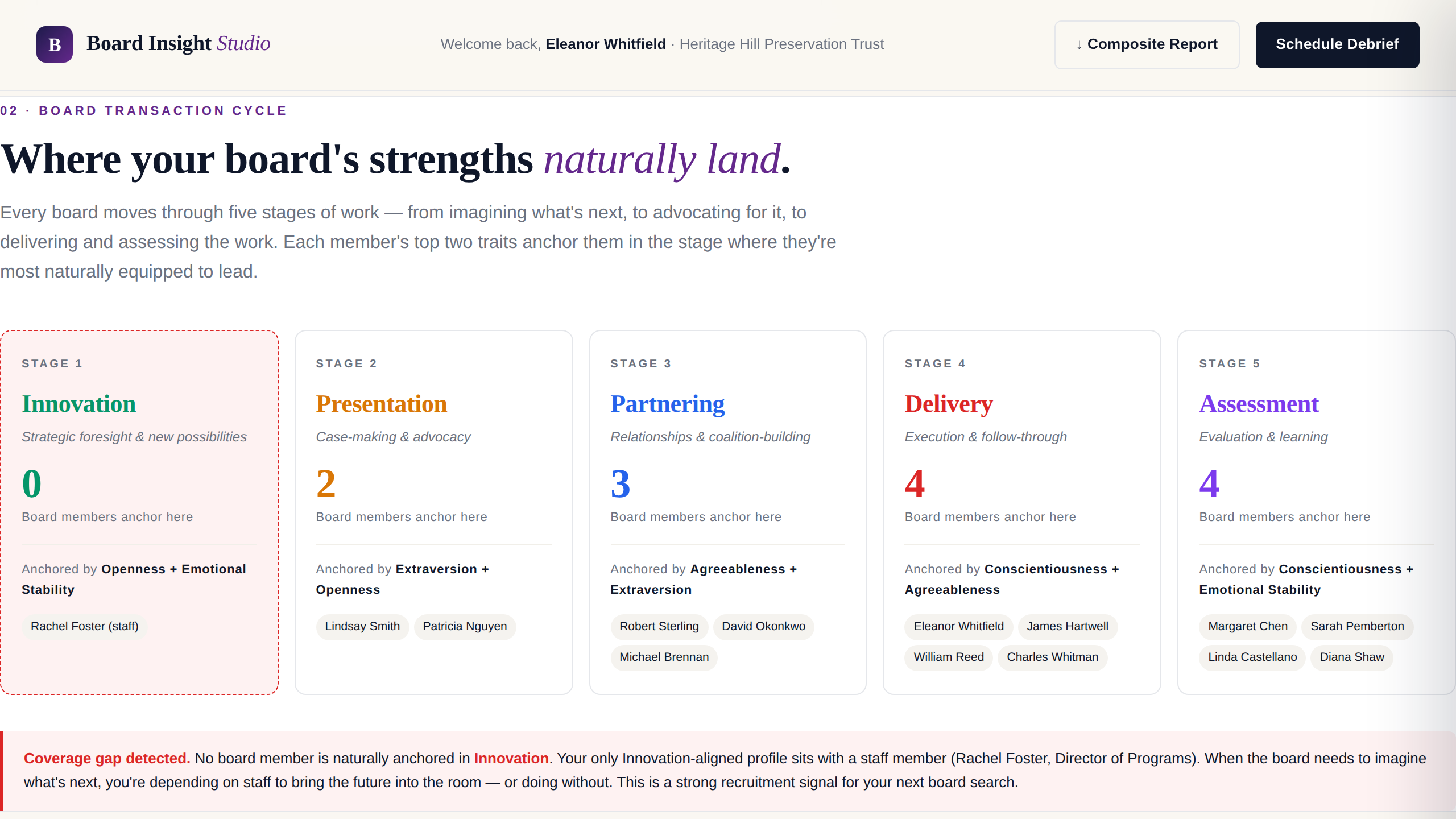
Sample Board Insight Studio dashboard showing the Board Transaction Cycle for a fictional organization, with five stages of board work and the board members anchored in each. Click to explore the live sample →
Preview of the dashboard each participating organization receives. Sample data from a fictional preservation trust.
01 · Profile

The shape of your board

A clear read of where your board’s collective strengths sit across the five Big Five dimensions, with a one-paragraph interpretation written for your specific board’s pattern.

02 · Map

The Board Transaction Cycle map

The collective view highlights patterns in the board’s reported strengths and working styles across five proposed areas of governance work. It is designed to support thoughtful discussion about possible areas of concentration, development, and future recruitment.

03 · Discussion

Role discussion prompts

Discussion prompts for committee roles, project leadership, and future recruitment. These are starting points for board conversation and professional judgment, not prescriptive assignments.

Individual participants receive their own personal reports. The collective dashboard is designed to present board-level patterns while limiting access to individual numeric scores and detailed personal-development language.
See the live sample dashboard → Opens in a new tab. No sign-up required.
The five stages

A board’s work follows a cyclical model.

Not dissimilar to a business work cycle, a nonprofit board moves through five distinct areas of work. Every area matters, and different strengths and working styles suit each one.

The Board Transaction Cycle is a proposed framework, adapted for nonprofit governance, that organizes board work into five connected areas for discussion and development.

STAGE 01

Innovation

Envisioning and generative work to keep the organization’s strategic direction mission-forward, no matter the internal or external environment.

STAGE 02

Presentation

Advocating for the organization and raising the resources that make its work possible.

STAGE 03

Partnering

Deepening the relationships that move the organization forward.

STAGE 04

Delivery

Good board governance practices. Performance monitoring for leadership, financials, programs, and board processes.

STAGE 05

Assessment

Evaluating the board’s and the organization’s performance to inform the innovation process again.

How it works

A developing board-development experience.

Board Insight Studio is designed to slot into a busy board calendar without creating burdens for volunteers or staff, and to deliver on one of the most meaningful board development goals in your strategic plan.

01

Explore Board Insight Studio for your board

Board leaders can contact Board Insight Studio to learn about the developing experience and future availability.

02

Participants may be invited to complete an assessment

Each person may receive a personalized email invitation with a unique link. The assessment takes about 15 to 20 minutes, and each participant may receive their own individual report and a short explainer video tailored to their profile.

03

A collective view may be prepared for board leaders

As assessments are completed, a collective view of the board’s emerging Transaction Cycle map may be prepared for designated leaders. Individual results remain confidential.

04

A leadership debrief may be offered

Designated leaders may meet with a facilitator to interpret the findings, understand the board’s composition, and talk through implications for governance and future recruitment.

05

Some boards may explore the work further

Boards that want to dedicate a full session to this work may explore an in-person facilitated session, one of the most engaging ways to pursue the board development goals many strategic plans include.

What this really is

Most board consulting teaches roles.
This illuminates people.

Typical board consulting

The “what” of governance

Most board consultants help boards understand their roles and responsibilities: duties, bylaws, fiduciary obligations, fundraising expectations, committee structure. That work is valuable and necessary. It is the framework of good governance.

Board Insight Studio

The “who” of governance

Board Insight Studio is a developing approach designed specifically for nonprofit boards that draws on established personality science, adapted for the important work of nonprofit boards. It is designed to illuminate the unique combination of people on your particular board, and how their working styles may shape the decisions, conversations, and relationships the organization depends on.

Both matter. Most boards get the first. Very few get the second. A shared language for who people are when they are at their best is the piece most board development leaves out, and the reason Board Insight Studio exists.

Current status

Board Insight Studio is being refined with nonprofit leaders.

Board Insight Studio is developing a practical, research-informed approach to helping nonprofit boards better understand the mix of strengths, perspectives, and working styles around their table. Limited pilot opportunities may become available as the development process progresses.

Contact Us

Commercial availability will be announced in a future release.

What makes it different

Why the Big Five informs our approach.

Board Insight Studio uses the Big Five personality framework because it is widely studied in academic personality research. The purpose is not to label people or prescribe fixed roles. It is to create a more useful shared language for discussing how individual differences may show up in nonprofit board service.

What we use

The Big Five (OCEAN).

A personality framework with a substantial body of academic research behind it.

The Big Five framework has a substantial body of academic research behind it, developed across decades, cultures, and languages, and organized around five dimensions: Openness, Conscientiousness, Extraversion, Agreeableness, and Neuroticism.

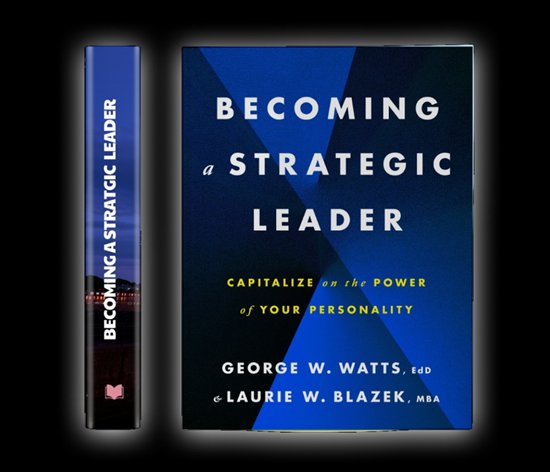
Board Insight Studio applies this established framework to nonprofit board development through a proposed Board Transaction Cycle adapted for the governance context, informed by the work of George W. Watts, EdD, and Laurie W. Blazek, MBA, authors of Becoming a Strategic Leader: Capitalize on the Power of Your Personality. Board Insight Studio uses this work with permission. This application is currently being refined and evaluated.

Don’t take our word for it SciShow · 14 min · 400K+ views

Here’s Why Personality Tests ALWAYS Work *

A mainstream science-education channel breaks down why many personality questionnaires feel accurate, and why the Big Five is treated differently in academic personality research.

Intellectual origins

The thinking that built this product.

Board Insight Studio draws on the thinking in Becoming a Strategic Leader and a question Karen S. Coltrane has been writing about for years: how to move beyond generic board duty checklists toward what each board specifically needs from each of its members.

Becoming a Strategic Leader by George W. Watts, EdD and Laurie W. Blazek, MBA — American Psychological Association, 2024
Becoming a Strategic Leader
Watts · Blazek
Foundational text

Becoming a Strategic Leader: Capitalize on the Power of Your Personality

George W. Watts, EdD · Laurie W. Blazek, MBA · American Psychological Association, 2024

“Watts and Blazek have crafted a sturdy foundation for leadership growth… a budget friendly, accessible alternative to executive coaching, offering a quick path to both personal growth and enhanced people development skills.” — Karen S. Coltrane, MS · published endorsement, APA

Learn more from the American Psychological Association →
Selected writing
Substack newsletter

The Business of Mission

Essays on running nonprofits as serious enterprises: leadership, capital campaigns, earned income, and the case that nonprofit management is management.

Read on Substack →
Published, January/February 2018

Meeting of The Minds: To get the most from your board, figure out what you need—and what trustees can provide

“Maybe we have asked and answered the question ‘What are a board’s duties?’ Now we can begin to ask, ‘What are this board’s duties?’”

View citation at AAM →
Behind the work

Built by someone who has lived both sides of the boardroom.

Karen S. Coltrane, MS is the founder of Board Insight Studio and a 35-year veteran of the nonprofit sector. She has led five nonprofits as chief executive and has worked with boards from leadership positions in many more, spanning higher education, healthcare, museums, trade associations, and human service organizations. She has served on numerous nonprofit boards and is a BoardSource certified consultant.

Coltrane also teaches the Big Five personality framework to undergraduate business students as an adjunct professor at the College of Charleston School of Business, where she brings the same Big Five framework that informs Board Insight Studio into the classroom. She also writes The Business of Mission, a Substack newsletter on nonprofit leadership and management.

Board Insight Studio grew out of a pattern she has seen across the nonprofit sector for more than three decades: boards filled with capable, committed people whose full potential is not always visible or well used, even though they want to contribute more. This product is designed to change that by aligning every board member’s strategic value with the real work of governing a nonprofit.

BA Economics, William & Mary MS Leadership, The Citadel BoardSource Certified B-School Adjunct Former CEO, 5 Nonprofits Author, The Business of Mission

Give your board a better way to understand itself.

Board Insight Studio helps nonprofit leaders move from good intentions to real insight. A shared language, a clearer fit between people and work, and a stronger foundation for the governance that great missions deserve.

Contact Us